A little vacation. . .
To the faithful readers of this blog (many of whom I know have been disappointed lately by the infrequent postings), I will be signing off until the start of the (secular) New Year.
Friday, November 24, 2006

Saturday, November 18, 2006
ENGLAND: Outrage as Church backs calls for severely disabled babies to be killed at birth
By NEIL SEARS
The Daily Mail
November 12, 2006
The Church of England has broken with tradition dogma by calling for doctors to be allowed to let sick newborn babies die.Christians have long argued that life should preserved at all costs - but a bishop representing the national church has now sparked controversy by arguing that there are occasions when it is compassionate to leave a severely disabled child to die.And the Bishop of Southwark, Tom Butler, who is the vice chair of the Church of England's Mission and Public Affairs Council, has also argued that the high financial cost of keeping desperately ill babies alive should be a factor in life or death decisions.The shock new policy from the church has caused outrage among the disabled.A spokeswoman for the UK Disabled People's Council, which represents tens of thousands of members in 140 different organisations, said: "How can the Church of England say that Christian compassion includes killing of disabled babies either through the withdrawing or withholding of treatment or by active euthanasia?"It is not for doctors or indeed anyone else to determine whether a baby's life is worthwhile simply on the grounds of impairment or health condition."
The church's surprise call comes just a week after the Royal College of Obstetricians and Gynaecology sparked fury by calling for a debate on the mercy killing of disabled infants.But it has been made in a carefully thought out official Church of England paper written by Bishop Butler for a public inquiry into the ethical issues surrounding the care of long premature or desperately ill newborn babies.The inquiry, by the Nuffield Council on Bioethics, began two years ago and its findings are due to be published in London - but the church's contribution to the debate has been leaked in advance.The Nuffield Council, an independent body which issues ethical guidelines for doctors, began the inquiry to take account of scientific advances which mean increasingly disabled and premature babies can technically be kept alive.In practice, doing so can be controversial - with the three months premature Charlotte Wyatt a case in point.The Portsmouth baby weighed just 1lb at birth, and had severe brain and lung damage. Doctors wanted to be allowed to leave her to die, but her parents successfully campaigned through the courts against them.Now that the child is three, however, and could be cared for at home, her parents have separated and are considered unsuitable to look after. In future cases doctors may work to guidelines proposed by the Nuffield inquiry.In the Church of England's contribution to the inquiry, Bishop Butler wrote: "It may in some circumstances be right to choose to withold or withdraw treatment, knowing it will possibly, probably, or even certainly result in death."The church stressed that it was not saying some lives were not worth living, but said there were "strong proportionate reasons" for "overriding the presupposition that life should be maintained".The bishop's submission continued: "There may be occasions where, for a Christian, compassion will override the 'rule' that life should inevitably be preserved."Disproportionate treatment for the sake of prolonging life is an example of this.The church said it would support the potentially fatal withdrawal of treatment only if all alternatives had been considered, "so that the possibly lethal act would only be performed with manifest reluctance."Yet the Revd Butler's submission makes clear that there are a wide range of acceptable reasons to withdraw care from a child - with the cost of the care among the considerations."Great caution should be exercised in bringing questions of cost into the equation when considering what treatment might be provided," he wrote."The principle of justice inevitably means that the potential cost of treatment itself, the longer term costs of health care and education and opportunity cost to the NHS in terms of saving other lives have to be considered."
The church also urges all the parties involved in care for critically ill babies should be realistic in their expectations, demands, and claims.The submission says: "The principle of humility asks that members of the medical profession restrain themselves from claiming greater powers to heal than they can deliver."It asks that parents restrain themselves from demanding the impossible.":UK Disabled Peoples Council spokeswoman Simone Aspis said the group's members were appalled that the Church was joining doctors in calling for disabled babies to be left to die."It appears that the whole debate on whether disabled babies are worth keeping alive is being dominated by professionals and religious people without any consultation with disabled people," she said.Out of babies born at just 22 weeks of pregnancy or less, 98 per cent currently die. In Holland babies born before 25 weeks are not given medial treatment.
By NEIL SEARS
The Daily Mail
November 12, 2006
The Church of England has broken with tradition dogma by calling for doctors to be allowed to let sick newborn babies die.Christians have long argued that life should preserved at all costs - but a bishop representing the national church has now sparked controversy by arguing that there are occasions when it is compassionate to leave a severely disabled child to die.And the Bishop of Southwark, Tom Butler, who is the vice chair of the Church of England's Mission and Public Affairs Council, has also argued that the high financial cost of keeping desperately ill babies alive should be a factor in life or death decisions.The shock new policy from the church has caused outrage among the disabled.A spokeswoman for the UK Disabled People's Council, which represents tens of thousands of members in 140 different organisations, said: "How can the Church of England say that Christian compassion includes killing of disabled babies either through the withdrawing or withholding of treatment or by active euthanasia?"It is not for doctors or indeed anyone else to determine whether a baby's life is worthwhile simply on the grounds of impairment or health condition."
The church's surprise call comes just a week after the Royal College of Obstetricians and Gynaecology sparked fury by calling for a debate on the mercy killing of disabled infants.But it has been made in a carefully thought out official Church of England paper written by Bishop Butler for a public inquiry into the ethical issues surrounding the care of long premature or desperately ill newborn babies.The inquiry, by the Nuffield Council on Bioethics, began two years ago and its findings are due to be published in London - but the church's contribution to the debate has been leaked in advance.The Nuffield Council, an independent body which issues ethical guidelines for doctors, began the inquiry to take account of scientific advances which mean increasingly disabled and premature babies can technically be kept alive.In practice, doing so can be controversial - with the three months premature Charlotte Wyatt a case in point.The Portsmouth baby weighed just 1lb at birth, and had severe brain and lung damage. Doctors wanted to be allowed to leave her to die, but her parents successfully campaigned through the courts against them.Now that the child is three, however, and could be cared for at home, her parents have separated and are considered unsuitable to look after. In future cases doctors may work to guidelines proposed by the Nuffield inquiry.In the Church of England's contribution to the inquiry, Bishop Butler wrote: "It may in some circumstances be right to choose to withold or withdraw treatment, knowing it will possibly, probably, or even certainly result in death."The church stressed that it was not saying some lives were not worth living, but said there were "strong proportionate reasons" for "overriding the presupposition that life should be maintained".The bishop's submission continued: "There may be occasions where, for a Christian, compassion will override the 'rule' that life should inevitably be preserved."Disproportionate treatment for the sake of prolonging life is an example of this.The church said it would support the potentially fatal withdrawal of treatment only if all alternatives had been considered, "so that the possibly lethal act would only be performed with manifest reluctance."Yet the Revd Butler's submission makes clear that there are a wide range of acceptable reasons to withdraw care from a child - with the cost of the care among the considerations."Great caution should be exercised in bringing questions of cost into the equation when considering what treatment might be provided," he wrote."The principle of justice inevitably means that the potential cost of treatment itself, the longer term costs of health care and education and opportunity cost to the NHS in terms of saving other lives have to be considered."
The church also urges all the parties involved in care for critically ill babies should be realistic in their expectations, demands, and claims.The submission says: "The principle of humility asks that members of the medical profession restrain themselves from claiming greater powers to heal than they can deliver."It asks that parents restrain themselves from demanding the impossible.":UK Disabled Peoples Council spokeswoman Simone Aspis said the group's members were appalled that the Church was joining doctors in calling for disabled babies to be left to die."It appears that the whole debate on whether disabled babies are worth keeping alive is being dominated by professionals and religious people without any consultation with disabled people," she said.Out of babies born at just 22 weeks of pregnancy or less, 98 per cent currently die. In Holland babies born before 25 weeks are not given medial treatment.
Monday, November 13, 2006

Heresy of Heresies!
More on the Free Church of England/Reformed Episcopal Declaration of Principles:
“This Church CONDEMNS and REJECTS the following erroneous and strange doctrines as contrary to God's Word:
That the Presence of Christ in the Lord's Supper is a presence in the elements of Bread and Wine.”
Oh my! What novel protestant nonsense is this? Obviously, a clear rejection of the “real and objective presence” of Christ in the Eucharist. . .well, not quite.
Let’s see if there are some other “reputable sources” we could quote that make the very same point:
Saint Thomas Aquinas:
“That one body should be at the same time locally in two different
places is not possible, even by a miracle. Therefore, the Body of Christ is not on the altar locally.”
Scriptum in Sent., lib. IV., dist. 44, ques. 2, art. 2, ad quar.
“A body is in place where its dimensions are commensurate with the dimensions of the place; and according to this, the Body of Christ is not present except in one only place, that is in heaven (secundum hoc corpus Christi non est nisi in uno loco tantum, scilicet in coelo).”
Ibid. lib. IV., dist. 10, ques. 1, art. 1, ad quin.
“It is impossible that the Body of Christ should be made present under the Sacrament by a local motion, because if this were so, it would follow that the Body of Christ would cease to be in heaven whenever the Sacrament was celebrated.”
Contra Gentiles, lib. IV., cap. 63.
“In no way is the Body of Christ locally in this Sacrament.”
Summa, III. 76. 5.
Vernon, on the doctrine of the Council of Trent:
“Not only may the body of Christ under the symbols be called a spiritual body, and Christ himself a spirit, but the body of Christ may be said to be under the symbols in a spiritual manner or spiritually, and not in a natural or corporal manner, that is neither corporally nor carnally.”
Regula Fidei. Ed. Brunner, p. 108
William Temple, Archbishop of Canterbury:
By means of the Bread He is present to our souls. He is not locally in the elements. ‘Corpus Christi non est in hoc sacramento sicut in loco’ is the explicit declaration of St. Thomas Aquinas. . .”
Christus Veritas, p 239.
Friday, November 10, 2006
A Very Brief Overview of the Reformed Episcopal & Free Church of England Declaration of Principles:
In response to Father Anderson's request to examine some of the foundational tenets of the REC I've prepared this very brief overview.
First let me state by saying that, like the Articles of Religion themselves, we must keep in mind the historical context in which the Declaration was written/adopted. Too often we read theology or actions within history without knowing what was actually being said and the context in which it was said or written. We rip apart the writings or actions of Luther or Cranmer (or Laud or Keble) for being "so extreme" without fully understanding what it was they were reacting to and why. We see the reasoned result of decades or centuries of theological debate and judge those that came before us with that rather unrealistic yardstick.
While the early Anglo-Catholics were reacting against lukewarm, rationalist, sedentary elements in the CofE that failed to see the CofE as the “Catholic Church in England,” it must be acknowledged that some of them went so far in equating “Catholicism” with 19th century Romanism (adopting the Latin Missal, Roman feast days, Roman doctrine, non-communicating High Masses, compulsory Confession, not allowing "non-Catholics" to the Eucharist, etc) that it was inevitable that many in the CofE and PECUSA would react against such extremism with their own manner of extremism. Not to say that the Declaration of Principles is "extreme," but many in the REC went so far in trying to eliminate all elements in Anglicanism that could possibly present "Roman germs" that it made Anglicanism into something like "Presbyterianism with a Prayer Book." In my opinion, neither side was right, but both had substantive objections as to why the other side was wrong.
This Church CONDEMNS and REJECTS the following erroneous and strange doctrines as contrary to God's Word:
First, That the Church of Christ exists only in one order or form of ecclesiastical polity;
(Paraphrase of the 17th century Anglican divines; Andrewes, Cosin, and Laud, while believing in the Divine Right of the Episcopacy, did not believe that the lack of an Episcopacy in other Christian bodies "de-churched" them. This was a concept introduced in the Tractarian movement, hence the reason for the inclusion of the point here. It is true that the Free Church of England and the REC in America have usually held that Episcopacy is not of "essence of the Church" but is ancient and apostolic and there is no reason to do away with it because it was the most ancient form of Church structure. However, like the later Continuing Church, these bodies have always been careful to obtain and preserve the Anglican episcopate).
Second, That Christian Ministers are "priests" in another sense than that in which all believers are "a royal priesthood";
("The Articles of Religion allow the use of the word priest as the anglicized version of the word presbyter by their consistent use of it to describe a minister of the Word and Sacrament (XXXII, XXXVI), and not as someone who can uniquely provide atonement (XXXI)" (from the web pages of the Reformed Episcopal Church).
There is a sense in which the Eucharist is sacrifice, but it is not a new sacrifice which the priest offers on his own behalf, and it adds nothing to the Sacrifice made upon the Cross--it is a memorial sacrifice, a Eucharistic sacrifice, but its sacrificial nature is eternally linked to a single and all sufficient Sacrifice. There is also a very real sense in which the ministers of Christ, both in Word and Sacrament, are serving a priestly function via the preaching of the Gospel and administering Baptism, Eucharist, pronouncing Absolution, performing anointing, etc., but the danger is there in thinking that these functions can be viewed as somehow "apart from" the Body of Christ, the Church, which itself is a priestly Body because it is united to the One True High Priest, Jesus Christ. We must remember that when those in the REC and FCofE adopted the Declaration many Anglo-Catholics (Anglo-Romans) in the CofE and PECUSA were adopting Roman theories of both the Mass and the nature of Holy Orders, making pronounced distinction between their thinking and the writing of the 17th and 18th century Anglican divines.
Also, I always have to wonder what is wrong with the term "presbyter"?--it is more ancient than the use of the term "priest" in Christendom, and widely employed in Orthodoxy.)
Third, That the Lord's Table is an altar on which the oblation of the Body and Blood of Christ is offered anew to the Father:
(Only a rejection of Anglo-Romanism: Table and altar are used interchangeably in Holy Scripture (Malachi 1:10, 12)--there is no real problem in calling the Lord's Table an altar, for it is here that the Sacrament of Christ's Body and Blood is celebrated. However, there should be no difficulty in calling it the Holy Table either. Also, take note of the word "anew"--this is the line of demarcation between saying that Christ is sacrificed again at the Eucharist or He is not).
Fourth, That the Presence of Christ in the Lord's Supper is a presence in the elements of Bread and Wine:
(Again, we have to take note of the word "in" the elements. The same view as that expressed by Cranmer, Hooker, Laud, etc; even Thomas Aquinas rejected the notion that Christ was localized in the elements. To paraphrase Cardinal Newman--when the host moves in procession, Christ does not move. A bit ironic using the official theory of Rome to explain and defend this stance, which I hold to, but there it is nonetheless. Even so, Keble and Pusey--to my knowledge--stick close to the Anglican Formularies and refer to the Presence of Christ's Body and Blood being "with and under" the bread and wine, not "in them" by way of a localized interpenetration. Rejecting Christ being "in" the elements is not a rejection of the objective Real Presence as presented by the Caroline Divines or by the early Anglo-Catholics. Again, take careful note of the phrasing: "The Presence of Christ in the Lord's Supper"--Christ's Presence is acknowledged--is not "a presence in the elements of bread and wine." Nothing un-Anglican, nothing even that goes against the founders of the Anglo-Catholic movement, only a rejection of the "prisoner of the tabernacle" mentality that was already in existence in Roman Catholicism and was growing in branches of Tractarianism).
Fifth, That Regeneration is inseparably connected with Baptism.
(More elaboration is needed to fully understand this statement. Bp. Cheney affirmed the doctrine of "ecclesiastical regeneration" such as that taught by Lord Bp. Browne in his Exposition on the Articles, but felt that he could not use the word in good conscience due to its meaning having changed in use by the late 19th century--here in the Declaration there is only the rejection that Regeneration is inseparably tied to Baptism, but not that it occurs at Baptism. For a full explanation of the historical theology of this point see Bishop Sutton's text on this issue; for a full understanding of the traditional Anglican teaching on the Sacrament of Baptism, see Bishop Browne's Exposition on the Articles).
Tuesday, October 24, 2006

Articles of Religion of the Church of England: XV. Of Christ alone without Sin.
"Christ in the truth of our nature was made like unto us in all things, sin only except, from which he was clearly void, both in his flesh, and in his spirit. He came to be the Lamb without spot, who, by sacrifice of himself once made, should take away the sins of the world; and sin (as Saint John saith) was not in him. But all we the rest, although baptized and born again in Christ, yet offend in many things; and if we say we have no sin, we deceive ourselves, and the truth is not in us."
In light of the recent Anglican-Roman Catholic statement tacitly accepting the Marian doctrine of the Immaculate Conception and the related ideas concerning her bodily assumption into Heaven, as well as in light of the fact that many modern Anglicans are open to these speculations, I think several factors need to be considered pertaining specifically to the Immaculate Conception: 1) This is not a “Catholic” doctrine; it is not accepted by the East nor by the West during the period of the Ecumenical Councils; 2) The Orthodox reject this doctrine, 3) The Old Catholics reject this notion; 4) Early Anglo-Catholics rejected this notion as “un-Catholic” and heretical. Its modern acceptance by many Anglo-Catholics is therefore noteworthy, troubling, and unfortunate. Per the Old Catholic rejection of the Immaculate Conception, the Fourteen Theses state:
"We reject the new Roman doctrine of the Immaculate Conception of the Blessed Virgin Mary, as being contrary to the tradition of the first thirteen centuries according to which Christ alone is conceived without sin."
Early Anglo-Catholic rejection of the notion of the Immaculate Conception is usually tempered by accepting notions of Mary’s perpetual virginity and high degree of sanctity. Even so, Westcott’s statements in his dogmatic theology text Catholic Principles illustrates the continuing problems with the doctrine in a manner similar to the Old Catholic reflection:
"The first example of a papal definition of doctrine made independently of a council occurred in 1854, when, under Jesuit influence, Pope Pius IX declared that the doctrine that the Blessed Virgin was "preserved in the first instant of her conception from all stain of original sin . . . was revealed by God, and is therefore to be firmly and steadfastly believed by all the faithful." We must be careful to note exactly what this doctrine means and involves. Anglican Churchmen do not deny that the Blessed Virgin may have been so sanctified by the Holy Ghost, that she was preserved from actually committing sin, though this is merely a pious opinion; nor do Anglicans dispute the Catholic tradition of the perpetual virginity of the Blessed Virgin. What the doctrine of the Immaculate Conception affirms is, that she did not inherit original sin, a sinful nature, the taint which has been transmitted from Adam; and if this be true, then it would seem to follow that the Blessed Virgin, and not our Lord, is the starting point of our redemption; the beginning of the new humanity, the second Adam; and that the inherited taint of sin was cut off by Mary, not by Christ; and that from Mary we inherit the new nature, rather than from Christ. Now of this doctrine, there is not the slightest hint in the Bible; and when it first began to be taught, it was controverted and disputed. St. Ambrose, St. Augustine, and St. Thomas Aquinas, taught the contrary; and the whole Greek Church has always repudiated it. It virtually contradicts one of our Lord’s unique attributes, namely, that He alone was born without taint of sin. If this doctrine be true, then salvation begins with the Blessed Virgin, rather than with Christ; and yet this doctrine was proclaimed in 1854, as a dogma divinely revealed."
Another point of concern would be that through the Immaculate Conceptions as the Romans teach it that you could argue that Christ's humanity, the humanity he took on in order to redeem it (kai o logoV sarx egeneto kai eskhnwsen en hmin; St. John 1:14), need not be subject to the suffering (hunger, thirst, pain) and death that resulted from the Fall if Mary were cleansed from every taint of Original Sin at her conception and then did not sin throughout her life (was she able not to sin, or not able to sin due to her arguably perfect human nature?).
If Mary is the New Adam (so to speak), rather than Christ, our new nature and redemption is brought to us not by Christ, but by the Virgin: "If this doctrine be true, then salvation begins with the Blessed Virgin, rather than with Christ" (Catholic Principles, Westcott, 1902). Then all of the Roman titles that have been allotted to the Virgin Mary would be accurate and valid and we're bordering on Christological heresy to the point of making Jesus superfluous. In short, the Immaculate Conception is an un-Catholic doctrine that contradicts the Scriptures.
Tuesday, October 17, 2006

All Saints Church,
Amarillo Texas
This is one of the best websites I’ve seen for a traditional Anglican parish—please check it out. Turn on your volume for the Gregorian chant.
http://allsaintsamarillo.org/
From the website:
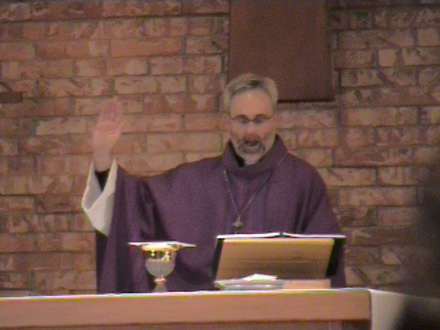
"At All Saints Church our aim is to help people understand they were made to love and worship God. This is why we exist. In the middle of the 4th century a man by the name of Augustine wrote this short prayer that summarizes our purpose, "Thou hast made us for Thyself and our hearts are restless until they find rest in Thee."
We believe there's one hour of the week unlike any other hour. It is Sunday's corporate appointment with God when we say with the Psalmist, "O God, thou art my God, I seek thee, my soul thirsts for thee; my flesh faints for thee, as in a dry and weary land where no water is (Psalm 63:1)."
Our worship is shaped and directed by the ancient liturgy. The theology and wisdom of these extraordinary prayers help us maintain a balance between doctrinal purity and warm-hearted devotion. C.S. Lewis captured our sentiments when he wrote the following,
"Every service is a structure of acts and words through which we receive a sacrament, or repent, or supplicate, or adore. And it enables us to do these things best...when, through familiarity, we don't have to think about it. As long as you notice, and have to count, the steps, you are not yet dancing but only learning to dance. A good shoe is a shoe you don't notice. Good reading becomes possible when you need not consciously think about eyes, or light, or print, or spelling. The perfect church service would be one we were almost unaware of; our attention would have been on God (Letters to Malcolm)."
All people are welcome in our church. The Bible affirms that we are all sinn
 ers in need of repentance, conversion and amendment of life. Hence, we open our arms to everyone and invite them to discover the transforming power of Jesus Christ.
We're especially interested in meeting people who are on a spiritual journey. People who value learning, reading and the collective wisdom of church history will feel at home at All Saints.
When you visit All Saints you'll be inspired by the wonder and pageantry of liturgical worship. The worship of God will awaken in you an unknown capacity for joy and you'll say with King David, "O God, You are my God; Early will I seek You; My soul thirsts for You; My flesh longs for You In a dry and thirsty land Where there is no water. So I have looked for You in the sanctuary, To see Your power and Your glory (Psalm 63:1).
Thank you for taking time to visit us on the web. We look forward to meeting you.
Monday, October 16, 2006
A Short Reflection on Terminology. . .
As the Patristic Anglican has pointed out on his blog on not a few occasions, the use of the term "Anglo-Catholic" is a bit elastic (at best); I sometimes lament that I even use the term, for it often confuses instead of clarifies: "Oh, that means you're closer to Rome--why don't you just 'join the Catholic Church'?" The follow up attempt to explain many of the points set forth in the post below will often lead to more confusion. Many people today proudly proclaim that they or their parish is "evangelical," but if you ask them if their priest wears a chasuble and celebrates the Eucharist every Sunday and they've already said they're "evangelical" you can point out that these are the marks of early Anglo-Catholicism. However, the parish may very well be "evangelical," for this is not a dirty word and it is not opposed to "Catholicism." Again, more confusion than clarity.
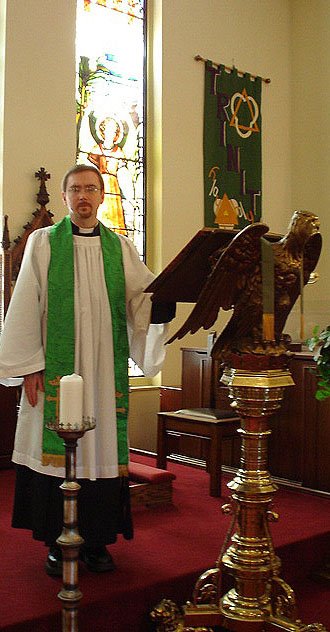
Similarly, terms such as "low church" or "evangelical" are often meaningless and usually depend on who is talking. One person will look at the service at St. Andrew's and call it "low church" because we don't use incense. Another will call it "just right" because it is nearly identical to the old Episcopal services from the 1950s. A third person will think us too "high church" or "catholic" because we're always making the sign of the cross and bowing (to the cross, to the Holy Table, at the Name of Jesus, at the Name of the Trinity, etc), and we've got all of those fancy gold vessels on the altar.
While I consider myself an "Anglo-Catholic," my thinking is most in line with the Caroline divines, the early Tractarians like Pusey and Keble, writers like Staley, and those who sought to conform the reformed Church of England to the theology of the ancient Church (so I also have an affinity for Eastern Orthodox authors such as Fr. Alexander Schmemann). I know that others will say, "Well, you're not really Anglo-Catholic" and then go on to expand the definition of the term to eliminate my line of thinking or place me into some other category.
I think that I and other like minded bloggers (if I may be so bold as to include writers such as the Patristic Anglican and the Anglican Parish Priest) are simply attempting to foster "mere Anglicanism" centered around the Bible, the Book of Common Prayer, and the teaching of the ancient Church.
Subscribe to:
Posts (Atom)